Taking the rise…
By Tony Pearson
Most walls in buildings need an injected damp proof course like a fish needs a bicycle! Now I know this might sound a somewhat bold – and odd! – statement but bear with me…
It’s often the case that you’re told that an injected damp proof course is required by the person that’s going to do the work. Why? Because they stand to get a sale and / or commission from the instruction. Call me cynical but that’s my experience – generally.
But why is a damp proof course required and is it just a place where terminology and assumption is used to secure a job? If we go back in time a bit first, we will find the foundations of the answers…
Question: ‘How were castles built inside moats’? A wall sits in water 24-7-365 at a time when silicon and other bitumen type damp proof materials weren’t available? The answer is the management of damp was designed into the wall. Those castle builders of the past were smart! In the case of the castle wall, the wall was built 1.2 metres thick as the capillary action of bricks and stones is only ever to a maximum of approximately 0.9 metres. By having approximately 0.3 metres to ‘spare’ the internal wall will never be damp or wet – the dampness was ‘managed’. The problem of rising dampness is now ‘arising’ (pardon the pun) due to other factors. But what are these?
To explain I’ll use the following example. Picture a towel hanging on a clothes line. It rains, the towel gets wet. It stops raining, the sun comes out and the towel dries. The dampness or moisture is free to move in and out of the towel and this is how a wall was designed to operate when the property was built. Now imagine the towel is wet and you put a plastic bag around it. What happens? All the moisture is trapped inside the bag and slowly the towel will rot and perish. That is what you’re doing when you start coating or encasing a wall with some sort of damp proofing material – you’re trapping all the moisture inside to slowly cause the wall to break down. It should be noted here that to completely dry out, a wall can require 6-12 months of no new moisture. Can you see a time when there could be 6-12 months of no rain in the UK so a wall can dry out sufficiently for damp proofing work to be effective?! Na, neither can I!
So, if your property is suffering from rising damp it’s probably caused by factors other than a lack of a damp proof course. For instance, when older houses were built with timber framed windows there was usually a certain amount of ventilation allowing moist air to escape. Modern windows often allow for no ventilation or moisture to escape and so the moist air in a property condenses on the wall and reveals itself as damp patches. Another cause which is particularly common with Georgian properties is they were usually built with vents in the wall. What would often happen is that someone innocently takes the vent out thinking it’s not doing anything as it’s not ventilating the foundations – as it sits above them. Mistake! The vents were there to get air moving ‘inside’ the wall to aid taking the moisture away. The vent goes, the moisture stays. Simples!
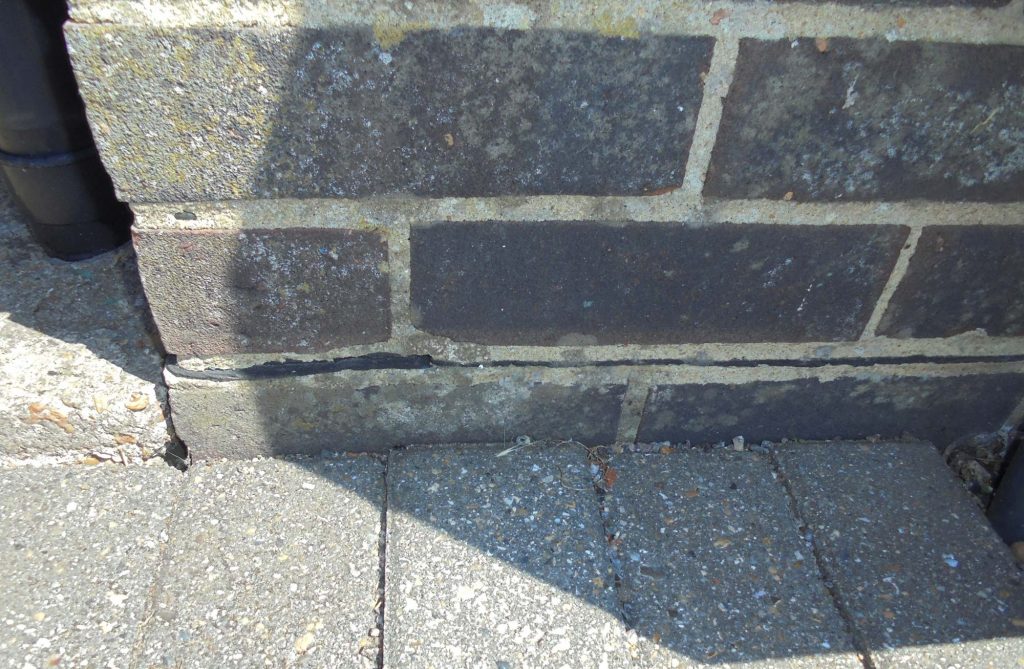
Finally, the most common cause for damp problems is external ground levels being too high. Look at the bottom of the outside walls to your property. There should be an extra thick horizontal line of mortar or something (usually black if felt; can be purple if slate; or maybe a line of metal) sticking out from the bricks. This line is the damp proof course (DPC) – if your property was built with one. This line should be at least two courses or rows of brick above the footpath, driveway or dirt level in the garden etc. If it isn’t, then the external ground levels are too high. Rather than look to pay for an injected DPC it will probably be cheaper to pay someone to lower the external ground level so that the DPC is at least 2 courses above.
So before you have a visit from someone who could well be a salesperson more interested in making a sale than giving you good advice, contact us and whilst we will charge a fee, you can be rest assured the advice you get will be what’s best for your property for the short and long term.